
By Lucinda Brown
The 2026 MUNTAG held by ISB was focused on the topic of ‘The Future of Borders’. To understand the direction in which borders must go, looking at the past is vital. There have been many events throughout history which have changed the course of thousands of lives, however most are documented and shown in the media. One instance of when conflict was hidden from the media was the fall of Yugoslavia. Here as a guest speaker, Alma Tadzic a Bosnian who was made a refugee as a child and is now a Grade 1 ISB teacher.
A brief History
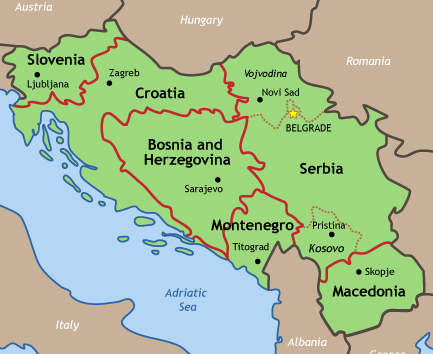
Across the course of history there have been three different Yugoslavia’s, all spanning different times. The first, a kingdom that was formed in the aftermath of World War 1. The second was socialist Yugoslavia which came about as the area was liberated from Germany’s rule in 1946 (Lampe). Yugoslavia was once one of the Balkans largest countries, as shown by the green area in Figure 1 (“The Conflicts”). It was split into smaller republics, which are 6 of today’s countries; “Bosnia and Herzegovina, Croatia, Macedonia, Montenegro, Serbia and Slovenia.” Being the 9th largest European country during its time, the diversity of Yugoslav citizens was large, encompassing three main religions, Islam, Orthodox Christianity, and Catholicism (“Yugoslavia Intro”). Multiple languages were used, the primary being Serbo-Croatian which over 12 million people spoke. All of the languages were South-Slavic to help as people from different regions communicated with each other.
The most known leader of Socialist Yugoslavia was Josip Broz Tito, who had not only helped form the country but helped to liberate the land from the Germans. Opinions about him differed between communities, he was often called a ‘benevolent dictator’ and by most, Tito was adored for being a far and just leader. In the 1974 constitution he was voted into presidency for life, and he kept his role until his death at 88 years old. His life was then celebrated with the largest recorded funeral in history at its time.
The Beginnings of Conflict
Between 1980 and 1990, Eastern Europe had many changes, with the fall of communism and nationalism in many countries, the people in Yugoslavia wanted change too. Militant organisations began to take a stance, leading to political crisis, many people wanted each republic to be independent from Yugoslavia. Others fought over the seemingly more powerful republics and lack of equality.
In 1991, Slovenia was the first republic to leave Yugoslavia and become their own country. Their act however was not done with permission from the Yugoslav government, who promptly fought against the decision with their military. This is now known as the beginning of the end for Yugoslavia, as their forces were met with Slovenian military and after a short conflict spanning only ten days, they were evacuated. This evacuation was only partly due to the failed attacks on Slovenia, and mostly due to the increasing tension and conflict in Croatia and Bosnia.
The Croatian conflict was not as straightforward as the Slovenian. While most Slovenians agreed with the movement to be independent, Croatians were not as open-minded. A large portion of people within Croatia belonged to the Serb ethnic group and wanted to remain either as part of Yugoslavia or as an independent state. This group of people took control of ⅓ of Croatian land and violently kicked out anyone not part of their ethnic group. By 1995 the Croatian government had seized full control of the country again.
Living through the most violent conflict
Like the other republics in Yugoslavia, Bosnia and Herzegovina wanted to be independent. However with the most diverse population other countries wanted to split the land up and divide it between themselves. Leaders from the three main religions were put forward and decided to lead the country together.
Alma Tadzic, was born in Bosnia and Herzegovina before Yugoslavia was disbanded. At the age of 8 Tadzic was subjected to the horrors of conflict. Bosnia was home, the place where all children feel safe and relaxed. Tadzic’s family was available through the phone, they would visit often and life was fun, predictable and calm, exactly how a childhood should be. That life came to a sudden stop after the conflicts in Bosnia began. Tadzic didn’t know that the last time she visited her family would be the last time she saw some of her Aunts or Uncles.
Using the landline in her house, Tadzic and her family were able to call their family. They were told that things were changing and everything was getting more dangerous. As a Bosnian Muslim (commonly known as Bosniaks) herself, Tadzic, a child under 10 at the time, was told about how her own family, neighbours, people that she knew, were being taken away purely because they had a different religion. Her family was forced by the Bosnian Serbs to wear white armbands to distinguish between Serbs and non-Serbs. This was what she would later come to understand as ‘ethnic cleansing’, when one ethnicity wants to completely push out another, often through extremely violent motions.
Through her landline, Tadzic would learn about how the conflicts were developing, one day everything would be okay, the next tanks driving through the streets and planes flying overhead. Everyone was told that they had to remain indoors for safety reasons, going outside could help planes flying overhead narrow down where people were.
When communication across the country was cut, things got worse. Bomb sirens became commonplace, whenever they would go off, everyone would have to run to the nearest bomb shelter. The distinct sound of bomb sirens remains to this day a trigger for bad memories for Tadzic. During her speech, Tadzic detailed the moment when she and her brother were running for a bomb shelter one night and he tripped, falling and breaking his foot. While ordinarily this could have been the cause of death, instead it was their saviour. Looking up from his fall, both Tadzic and her brother noticed the destruction in front of them, which they would have been caught in, had he not fallen. There came a time when there was no time to run for a bunker and blackouts would occur. Families would need to make sure that no light shone through any windows, this included candles and those small lights on the TV’s. Any light would alert planes flying overhead as to where they would need to target. Everyone was forced to “hide and hope” (Tadzic).
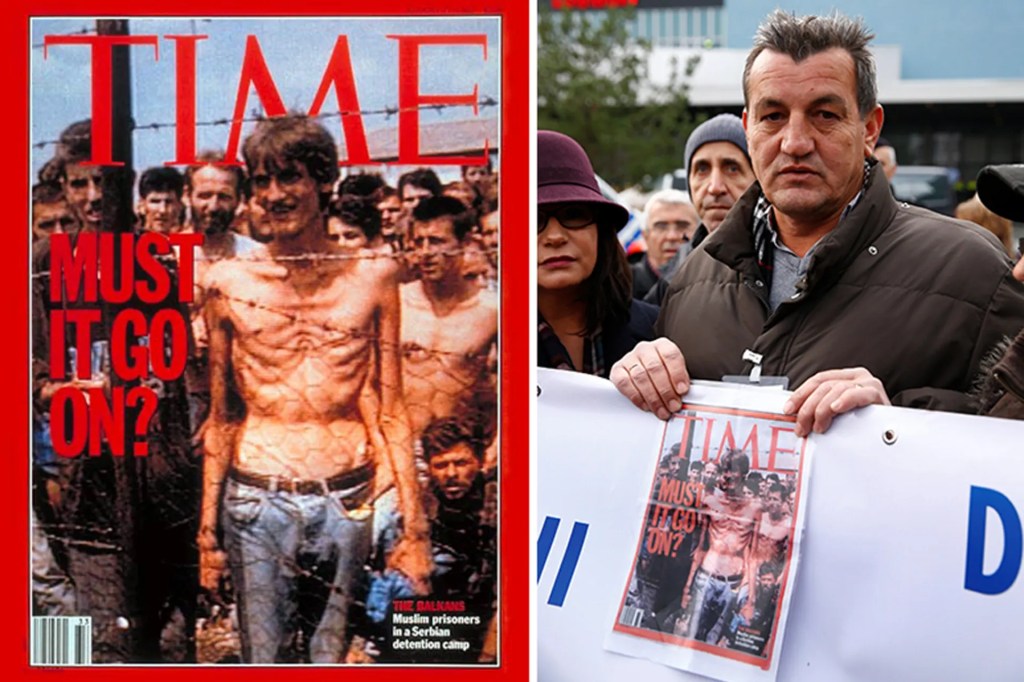
Neighbours, friends and trusted associates came one day to take the men and boys to camps across the country. Families were split and for many it would be the last time that they ever saw their family. These camps were the worst concentration camps to occur since World War 2, victims were tortured and starved, thousands killed in the name of ethnic cleansing. Figure 2 (John) shows a Fikret Alic, a man Tadzic knew from her Village who was a victim of the Bosnian concentration camps. The two images side by side show the extent of the starvation which the prisoners in the camps were victims of.
The chance to escape came for Alma Tadzic in the message of a bus. For many, it would be hard to understand why she didn’t want to leave but despite the danger and the conflict, her house was still her home, the place where she had grown up, the streets where she had played, the friends she had loved. That was what she would be leaving, and leaving without knowing where you’re going or if you will ever come back must have been one of the hardest things that Tadzic did. They left so quickly that there was no time to pack anything, taking only her teddy bear and a stone from her garden on her way out, when you’re a refugee “everything is left to save yourselves” (Tadzic).
Tadzic and her family were transported on a bus across borders and countries until finally arriving in England. She and the other refugees in the bus, were some of the first to escape the conflict and arrive in England and the situation had not been properly publicized yet, making their arrival harder. Many would think that the journey ends there, but even after arriving in a safe country, Tadzic had to adapt to an entirely new language, a new culture, new people and a new home.
It was there in England where Tadzic went to school and grew up, across 7 years she went to 5 different schools and 5 different cities. This constant movement sparked her interest in being a teacher as she was able to see the difference that a good teacher had on children. She continued with her education through University, being the first in her family to work towards and receive a University degree.
Once the conflict in Bosnia had been resolved, many refugees wanted to go back and see what their homes looked like. It was on one of these trips that Tadzic met her husband, a fellow refugee from her village, and fell in love. She moved to France to be with him, continuing her teaching career at an international school in Zürich before coming to ISB. Now, everyday she crosses a border and “Birds are flying instead of bullets” (Tadzic). Still, the repercussions are seen throughout her life. She and her husband have needed to explain to their small children why some family members are missing and why when they visit Bosnia, their fathers house has been turned to rubble. In Bosnia, mass burial sites are still being found, revealing people who were thought to have been completely lost and showing the true extent to the killings that occurred.
Today, Bosnia looks different, offices now take up the space that was once a concentration camp. Burial sites and graveyards fill once empty and bright fields. A conflict like this is not over when the fighting stops. No one can forget the horrors that once filled the streets, the divide between the happy memories of their childhood and the trauma of being attacked along those same streets.
A refugee does not go through only the physical journey to escape conflict, but they also have the emotional journeys that often stay with them for life. Being a refugee is not something that you can ever imagine. The experiences that they are forced to go through you would not wish upon anyone. “Resilience is not a choice, it becomes a part of life” (Tadzic).
Looking Forward
In schools, students learn about the Holocaust, they learn about World War 1 and World War 2, but they don’t learn about conflicts like these nearly enough. Alma Tadzic’s experience is one of millions, and while she was able to get out of the country early into the conflict, her husband along with many others were not as fortunate. In just her village of Prijedor, 5,200 people were killed in 1992, and that was only in one village, think of how many others were killed across the country. Educating students in subjects like these will help them as they grow up, they will learn more about the world and about groups of people who may one day be their friends. The children today are the future of tomorrow, and learning about these conflicts at an age when they can understand what happened is vital in teaching them the importance of being open-minded and stopping any form of discrimination.
After Alma Tadzic’s speech to the delegates and students at MUNTAG, everyone was moved. Researching a subject or conflict and hearing it from a survivor are two completely different situations. No one can believe how a conflict can so brutally impact a person’s life. The most shocking fact is that despite these wars happening in the past, lessons have not been learned. Tadzic herself spoke of how the situation in the middle east right now is extremely similar to what happened to her. Every country will have a reason for an attack, whether it be land, religion or something else. But that reason will never justify the children forced under their dining room tables during a blackout, scared of the dark. It will never justify the men and women in concentration camps or those still affected by the sounds of sirens because it reminds them of running for their life. Looking into the future, more effort needs to be put into helping and protecting the innocent lives caught up in wars.
Works Cited
“The Conflicts.” United Nations International Criminal Tribunal for the former Yugoslavia, http://www.icty.org/en/about/what-former-yugoslavia/conflicts. Accessed 24 Apr. 2026.
Djokić, Dejan. “Ten Days that Ended Yugoslavia: The Forgotten War in Slovenia, 30 Years Later.” ZOIS, 6 Oct. 2021, http://www.zois-berlin.de/en/publications/ten-days-that-ended-yugoslavia-the-forgotten-war-in-slovenia-30-years-later. Accessed 24 Apr. 2026.
John, Tara. “The Story of This Shocking Image From a Prison Camp in Bosnia Continues 25 Years Later.” Time, 22 Nov. 2017, time.com/5034826/fikret-alic-time-cover-bosnia/. Accessed 25 Apr. 2026.
Lampe, John R. “Yugoslavia.” Britannica, http://www.britannica.com/place/Yugoslavia-former-federated-nation-1929-2003#ref228362. Accessed 24 Apr. 2026.
Tadzic, Alma. Speech. International School Basel MUNTAG, 25 Apr. 2026, Basel, Switzerland.
“Yugoslavia Intro: a quick summary.” Yugotour, yugotour.com/blog/yugoslavia-intro/. Accessed 24 Apr. 2026.
 Posted by
