By Lucinda G11
Kashmir is a region in the Northernmost tip of India and bordering North-Eastern Pakistan. The region itself is often called ‘Paradise on Earth’, for its stunning scenery and amazing food. Home to much of the Himalayan mountain range, the snow covered peaks and glistening lakes make it a large tourist destination (SOTC Admin). Despite all of this, Kashmir is an area of great dispute between Pakistan, India and the region itself.
The Beginning of Conflict
Before the partition of 1947, there were many disagreements and conflicts in order to decide the borders and boundaries of the Kashmir area. It was hard to create borders because the civilisations were so spread out and had different customs which favoured different regions. It was during the partition, when India and Pakistan became two independent countries, that Kashmir had the choice of which nation to join. The maharaja, the leader, at the time wanted to become independent from both countries. However, a small revolution in Kashmir and the conflict that the partition brought to the people in India and Pakistan led him to choose to join India.
The decision to join India over Pakistan caused a localised warfare (Britannica Editors), which continued into the next year. Pakistan fought against the decision, claiming that Kashmir, being a majority muslim population, was an extension of their land and therefore belonged to them. India, wanting to put an end to the conflict, called upon the UN to help. With their help a ceasefire was put in place in January of 1949.
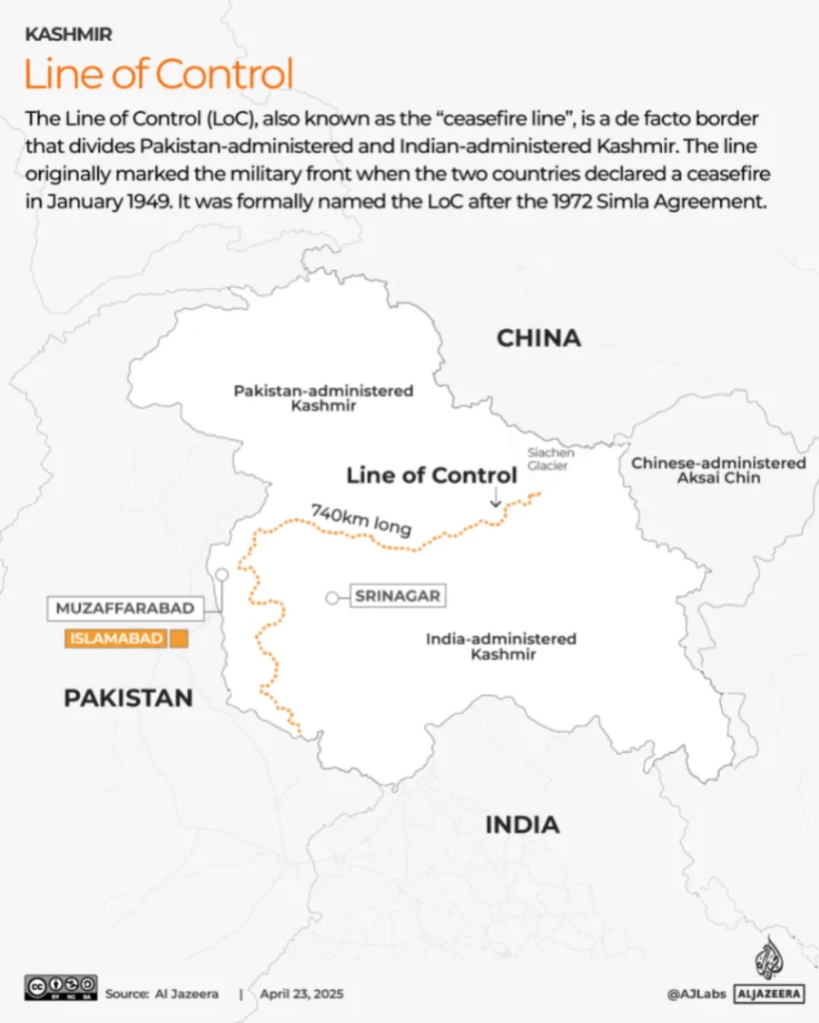
As time continued, tensions between the two countries grew, and it wasn’t until later in the century when the issue of control was properly confronted. During the 1972 conflict which gave Bangladesh independence, the countries signed a peace treaty entitled the Simla Agreement (Teekah) which had strict protocols regarding peaceful coexistence. Within this treaty, the matter of Kashmir was discussed and the region was split with the line of control, this is commonly known as the LoC, this can be seen in the image on the right (Hussain). The placement of this administrative border however placed the largest muslim population under Indian control and the largely uninhabited and underdeveloped portion to Pakistan.
While this line of control still exists today, its effectiveness slowly wore off as time wore on. The president of Pakistan at the time of the treaty was arrested and executed for the alleged murder of a political opponent (“‘Two Men”). His execution left the countries once again back in conflict.
A Bid for Independence
Across Kashmir, people were frustrated with the lack of development or any kinds of movement in the right direction. This led to the people of Kashmir taking things into their own hands and creating militant insurgencies. One of the largest groups was the Jammu-Kashmir Liberation Front (Hussain), the support grew for this group and Indian control seemed to slip. This continued until the 1987 elections, when controversies came out about the votes being rigged to favour someone who would keep out Indian control. Recognising this, India came back into the region with a renewed sense of urgency making sure that all of the insurgent militant groups no longer had any standing, this put a stop to any hope of the region gaining full independence. Despite this, the region had a semi-autonomous standing, giving them small freedoms from both India and Pakistan.
Recent Conflicts
In 2016, conflicts arose again when a bus in Kashmir was attacked leading to the death of 19 soldiers. This occurred in Uri, an Indian-administered part of the region. The 19 soldiers were on their way to the LoC to protect the border when they were attacked by militants. The Indian Government came in to look at the scene and allegedly found symbols belonging to the Jaish-e-Mohammad group (Sasikumar), and thus held them accountable. In retaliation for these deaths, India organised what they called a ‘surgical strike’ on army camps in Pakistan, killing an estimated 70-80 men (Sasikumar). Pakistan, in an effort to stop large scale conflict stated that any cross-border attack simply hadn’t occurred and the deaths were an ‘existential phenomenon’. This considerably reduced the possible backlash from both people and militant groups that could have occurred.
Later in 2019, a suicide bomber in Jammu in Kashmir drove his car into a bus full of police cavalry, leading to the death of 40 police officers. The suicide bomber, Aadil Ahmad Dar, had joined the terrorist organisation Jaish-e-Mohammed and they promptly took responsibility for the attack. Despite the Pakistani Government denying any involvement, the fact that the terrorist organisation is a Pakistan-based group led to India’s retaliation. Not wanting to harm more civilians but also having been condemned for not taking strong action, the Indian Prime Minister chose political retaliation. Modi, the Prime Minister, was able to remove Pakistan’s Most Favoured Nation Status (Sharma). This will lead to more import duties on goods entering India from Pakistan. Additionally, India made the executive decision to restrict the flow of water that enters into Pakistan from Indian rivers. These actions were able to show retaliation while also limiting violence and death.
The most recent deadly attack took place in April of 2025, when a shooter opened fire on tourists. Military personnel were quickly rushed onto the scene and the borders between India and Pakistan within Kashmir were heavily fortified. 26 tourists were killed in the shooting, and India was quick to retaliate (Biswas). Once again, the water treaty between the two countries was consulted, and India completely stopped the treaty. Since this attack, none of a similar scale has taken place, however that does not mean that the conflict has been resolved.
Future Expectations
While retaliation from both countries for violent attacks has been kept mostly political, the attacks themselves are deadly. It is not likely that these attacks will stop soon, due to them being organised by terrorist groups and not governments themselves. The likely path forward is continued tensions however if more attacks arise, the public pressure on retaliation will increase, which will hopefully lead to a larger incentive to stop any violent strikes in the future.
Works Cited
Biswas, Soutik. “Pahalgam Attack: How Will India Respond to the Kashmir Killings.” BBC, 23 Apr. 2025, http://www.bbc.com/news/articles/cwynx7kgyqvo. Accessed 24 Feb. 2026.
Britannica Editors, editor. “Kashmir.” Britannica, 23 Feb. 2026, http://www.britannica.com/place/Kashmir-region-Indian-subcontinent/The-Kashmir-problem. Accessed 24 Feb. 2026.
Hussain, Abid. “Pahalgam attack: A simple guide to the Kashmir conflict.” Alja Zeera, 2 May 2025, http://www.aljazeera.com/news/2025/5/2/pahalgam-attack-a-simple-guide-to-the-kashmir-conflict. Accessed 24 Feb. 2026.
Sasikumar, Karthika. “India’s Surgical Strik gical Strikes: Response t es: Response to Strategic Imper ategic Imperatives.” San Jose State University, Apr. 2019, scholarworks.sjsu.edu/cgi/viewcontent.cgi?params=/context/pols_pub/article/1028/&path_info=India_E2_80_99s_20Surgical_20Strikes_20__20Response_20to_20Strategic_20Imperatives.pdf. Accessed 24 Feb. 2026.
Sharma, Ashok. “Pulwama Terror Attack: India’s Response Escalates.” Australian Institute of International Affairs, 27 Feb. 2019, http://www.internationalaffairs.org.au/australianoutlook/pulwama-terror-india-escalates/. Accessed 24 Feb. 2026.
SOTC Admin. “11 Reasons Why Kashmir is called ‘Paradise on Earth.'” SOTC, 4 Feb. 2025, http://www.sotc.in/blog/indian-holidays/11-reasons-kashmir-called-paradise-earth. Accessed 24 Feb. 2026.
Teekah, Ethan. “Simla Agreement.” Britannica, http://www.britannica.com/topic/Simla-Agreement. Accessed 24 Feb. 2026.”‘Two Men, One Grave’ — The Execution of Pakistan’s Ali Bhutto.” ADST, adst.org/2013/04/sins-of-the-father-pakistans-bhutto-executed-april-4-1979/. Accessed 24 Feb. 2026.
 Posted by
  ISB MUN