
By Lucinda G11
Disclaimer: The article references debates ongoing in the BaMUN 2025 Conference, not real-life occasions. Please read the ICC-specific procedure on BaMUN 2025 Conference Information Post.
A Brief History
Rodrigo Duterte (Figure 1), was born in the Philippines into a politically active family. His father was a governor of the province of Davao, and his mother worked in the community as an activist, playing an important role in the movement that “deposed the authoritarian president Ferdinand Marcos” (Ray). Having been exposed to politics from a very young age, it is no surprise that Duterte himself went into politics. He followed in his father’s footsteps and began his political journey as mayor in 1988. After his time was completed, he was not allowed to return to his spot as mayor immediately, and so became a chair on the Philippines Chair of Representatives. When he returned, he was re-elected and then became vice mayor to his daughter. During Duterte’s many terms as mayor, Davao was transformed into one of the safest areas in the country. This was not without sacrifices. Duterte was nicknamed “The Punisher” for his extreme actions against those breaking the law. Despite the city becoming one of the safest areas, more and more deaths were occurring as a result of its harsh regulations.
Because of his reputation of creating safe areas, Duterte was elected to the presidency in 2016 with an overwhelming majority. Duterte promised his people that he would put a stop to the growing drug problem, stating in front of Filipino citizens that “Hitler massacred three million Jews. Now, there is three million drug addicts. I’d be happy to slaughter them” (“Philippines President”). Not only does this statement show his willingness to kill his own people, those suffering from a disease no less, but he also praises Hitler’s actions during a genocide. Over the course of his presidency, a reported 6,000 deaths occurred as a result of his Davao Death Squad, claiming that these deaths were purely a consequence of the war on drugs and not the aim of his policies. However, the executions exposed inner disparities, evidence suggesting that many wealthy drug lords were let go, while many in poverty were victims of the Death Squad. Creating rumours that the Death Squad and Duterte were targeting those in poverty and attempting to lower the levels of poverty in the country. All of these reasons led to an investigation from the ICC, which has led to the arrest of Rodrigo Duterte and his facing trial.
Figure 1– Image showing Rodrigo Duterte (Ray)
BaMUN ICC
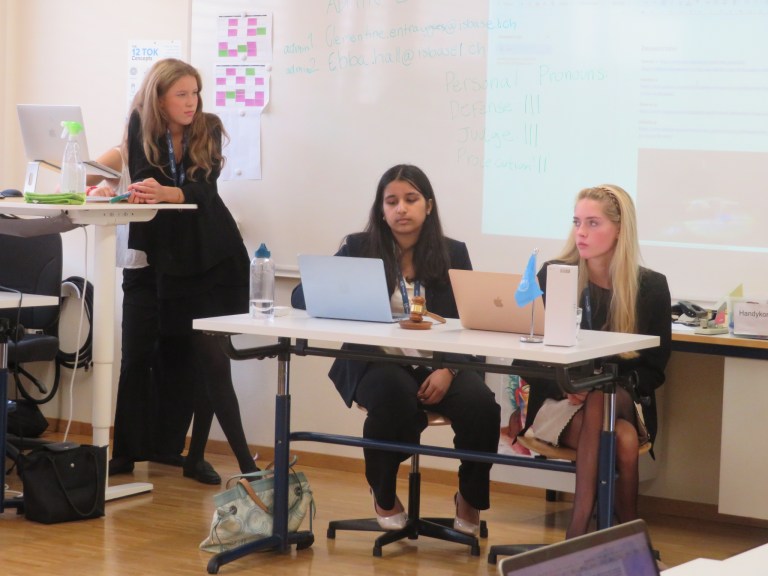
On the 1st of November 2025, Duterte’s legal team, the prosecutors, judges, and presidents came together during Basel MUN to debate on whether or not Duterte’s crimes are alleged or true, and if they are true, what the punishment will be.
In order to begin an ICC trial, both the prosecution and the defense must create a list of events and data called ‘Stipulations’, these are pieces of information that both sides have agreed are true. Meaning that they cannot be refuted at any point through the trial and can be used in favour of either side of the debate. The defense and prosecution agreed to 6 stipulations for this trial. The first was that the Philippines was between the years of 2011 and 2019 a signed State party to the Rome Statute. Because of this, the ICC has no jurisdiction over anything outside of that time; thus, anything that happened after the 17th of March 2019 cannot be used at any point throughout the trial. Next, the fact that there were an exact number of 5,526 deaths (approx. 6,000) during this time, which were documented by the government and were in relation to the anti-drug campaign that Duterte created. The third stated that during a period of 6 years, beginning in 2016, there was a nationwide anti-drug campaign known as the Philippine Drug War, whose goal was to reduce all aspects of drugs within the Philippines’ borders. Importantly, this campaign was publicly supported by Duterte. Additionally, Duterte was arrested at Ninoy Aquino International Airport on March 11, 2025, and transferred into ICC custody. And lastly, one small stipulation was that the Davao Death Squad did indeed exist and was a government-funded and initiated group.
The prosecution began its opening statement by detailing the lives that have been lost due to Duterte. Not only that, but victims have had their belongings stolen during house raids under the excuse of ‘suspected drugs’. This started as a war on drugs, but instead has become a “war on the poor” (Members of the prosecution). Those living in marginalized communities are disproportionately affected by Duterte’s policies. There has been a pattern of violence and bias against those with less money in the Filipino community. More information on the matter was given after questions from the judges. Bringing forth information about reports of more high-profile suspects and wealthy major drug lords being spared consequences and punishments, shows the lack of legitimacy in law enforcement.
The defense wholeheartedly rejected the ‘unfounded’ accusation. Duterte was elected to the presidency through a complete democracy, with 6.6 million more votes than his competitor. Duterte wanted to do what any president would: stop his people dying from the drug crisis that was claiming the land. All of the information against his actions is a mischaracterisation of legitimate police operations. His so-called ‘death squads’ were fully controlled, and the protection of citizens has always been the primary reason for them. The defense argued that the killings are justified due to the high number of drugs, and even though many of the people killed were not related to drugs, they were still criminals, and thus deserving of death. In these cases, people such as alcoholics, drug addicts (not dealers), and/or pickpockets were victims.
Evidence and Rebuttals
The Prosecution came forth first, describing multiple events in which Duterte himself flippantly admitted to killing someone at the age of 16, saying he ‘maybe stabbed somebody to death’. Which is arguably a clear show of his character. Additionally, there were many separate incidents reported where there had been no need for lethal firearms. One such being that an undercover operation had been happening and a dealer had sold drugs to the police. In this specific scenario, the police opened fire first and without warranty. Situations similar to this have occurred, where they enter a building already with their guns raised, in a public setting as well. To make matters worse, in situations where people were attacked in their houses, it was found that the police officers often raided the house of valuables before they left. Duterte also declared in several speeches, his intent to harm individuals, then after saying how it was a joke, but these thoughts have influenced his policies.
In response to these claims, the defense argued back. Citing that any incident that happened, which may have been against the law, was not in fact a reflection of Duterte, as it was the individual themselves who made the decision. Thus, he shouldn’t receive blame for any of those actions, essentially saying that without proof of command, there is no way to show that the actions of a few individual police officers are a reflection of his rule. Additionally, anything that Duterte has said in his public speeches does not instantly become a policy or a law; the defense made this point while asking the prosecution if they had ever said they were going to do something which they ended up not doing. In defense of Duterte, they brought up concrete evidence that his policies have indeed changed the crime demographic in the Philippines. The crime rate dropped 73.3% under his new laws and policies, with more and more people afraid of the consequences.
Witnesses
Both the prosecution and the defense brought forth three witnesses. Some having personal connections to Duterte and some speaking only on the topic at hand. The persecution began with Edgar Matobato, who was a member of the Davao Death Squad before becoming a whistleblower and helping the truth come out. Matobato was a member of the death squad for over twenty years, working under the order of Duterte. Their initial goal and the orders they received were to rid the city of criminals, but he said that as time wore on the orders changed. Matobato stated that he began receiving orders to kill those who opposed Duterte. The operations were organised and people were easily killed, then having their bodies dumped in nondisclosed areas. Matobato made sure to tell the judges that Duterte often oversaw the operations, and thus his involvement cannot be refuted. During one mission, three young women were captured and killed, Matobato said he was told they were drug addicts, but that he was sure they were innocent and had nothing to do with the war on drugs or any other form of criminality.
This witness was followed by two more, João Castel-Branco Goulão and Analyn (last name not stated). Goulão, having no connection to Duterte at all, came to discuss his view on how the war on drugs should be effectively handled. He himself is Portuguese, where small amounts of drugs were decriminalized in 2001. Since then general crime has significantly decreased, showing what can happen when things are treated with thought and not violence. The support system for those with addiction in Portugal has been found to help immensely, with counseling, rehab and education all available. The next Witness was Analyn, who had had her home broken into by the Davao death squad and her own husband murdered. She said that she had been filling up a bottle of milk for her newborn when she heard a knock on the door. The next thing she knew, her husband had been shot and her house raided. Analyn said that money she had been saving to pay the electrical bill had been stolen, as well as shoes she had just bought for one of her three children. The excuse they gave for his death was a ‘suspicion of having drugs’. Analyn promised that she trusted and knew her husband and he was not involved in anything to do with drugs. Their family was poor, and Analyn made it known that she had been targeted for such.
All of these witnesses highlight the reality behind Duterte’s rule. That maybe while richer neighbourhoods had gotten safer, it was at the sacrifice of those in other communities.
The defense then brought up to the stand their own witnesses, Dante Yemeniz, Ronald De La Rosa and a Mr Hernandez. Yemeniz was brought forward as the former chairman of the PACC, which works towards ensuring that no one in any form of power is corrupt. They work closely with the department of justice and the governmental office. Yemeniz stated that there had been accusations of corruption, which had been thoroughly investigated and led to the conclusion that the casualties were due to the action of individuals and thus Duterte was found innocent. The next witness, Ronald De La Rosa is the former chief of the national police force. Having said that his main goal was to safeguard the communities especially the youth, he believes that any cases of abuse of power were individual and isolated. In response to the war against the poor comment, De La Rosa argued that it was a war against the poison that was infecting their streets. Throughout his time on the stand, De La Rosa maintained that he and other members of the police force would not go against their ethics and their beliefs even if they were ordered by Duterte, and thus he believes that Duterte was innocent and had been helping the country during his rule. The last witness called to the stand was Mr Hernandez, a director of a local community centre. He detailed the life in the community before Duterte was put into power. With children unable to walk to school alone, adults not leaving their homes, substances found all over the place and more conditions which left it unsafe for living. However, Hernandez said that after coming to power, Duterte helped the community in so many ways. With less drug crime in the streets, people attended the community centre more often. Those who would usually skip classes to hang out with friends were volunteering to help in the new community outreach programmes. Sports and other group activities were made more common and the community became one again.
In contrast to the first few witnesses, these detail a hero of a leader who saved his people from those wishing to gain nothing but trouble. From these points of view, it seems as though Duterte really only wanted to help and make his community a safer place for everyone.
The Final Discussion
After hearing all of these reasons, statements, statistics, testimonies, and more, the judges were forced to come to a decision. To let a hero help his people, or to condemn a heartless killer? The judges left the room to make their decision. Weighing up both sides of the stories, the judges came together in a decision. Guilty on all charges and to serve forty years in jail for his actions. Charged with murder, abuse of power, and more, the truth has finally been set free. Forty years for 6,000 reported lives. For the families of those lost who have had to suffer in the knowledge that they can’t do anything. Those 6,000 lives lost finally found justice. To quote the prosecution, “Silenced in life, they can finally be heard in law.”
Works Cited
“Philippines President Rodrigo Duterte in Quotes.” BBC, 9 May 2016, http://www.bbc.com/news/world-asia-36251094.
Ray, Michael. “Rodrigo Duterte.” Britannica, http://www.britannica.com/topic/Rodrigo-Duterte. Accessed 1 Nov. 2025.Rodrigo Duterte is both hugely popular and controversial. BBC News, docs.google.com/document/d/1zNbFz_rqHhQXhekO7r-s_S8UxpT2sx92f_cCKLPY_o0/edit?tab=t.qkkdixgxv9mb. Accessed 1 Nov. 2025.
 Posted by
  ISB MUN