
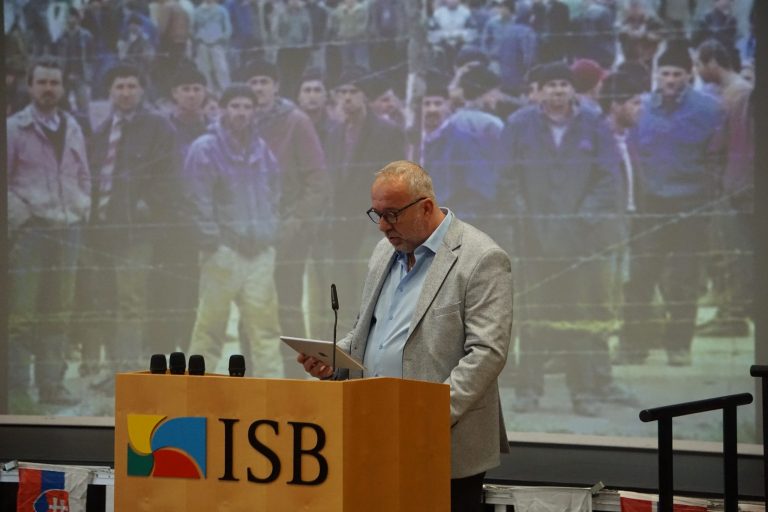
Our guest speaker from BaMUN 2024. Satko is a Bosnian that has survived the Yugoslavia concentration camp targeted at Bosnians. He now lives in the Netherlands and hopes to share his story with as many people as possible, specifically the younger generation so we can learn from their generation’s mistakes.
What do you hope to express to younger generations through sharing your story?
When I was released from the camps in 1993, I initially vowed to never speak about what I had witnessed. The atrocities were too overwhelming to process. But eventually, I realised that remaining silent was not an option. I felt a duty to tell my story as well as the stories of others. So we can learn from our past and hopefully not repeat them. However, the horrors I’ve experienced are still seen and are echoed by survivors from Syria, Rwanda, Ukraine. The message I want to give to the younger generations is to face these painful histories, to give sense to the senseless violence and murder that have taken place. We must learn from the past, confront it, and use it to prevent further repetitions of history.
What advice would you give to your younger self or to people going through conflict today?
Be self-critical. Look at your own past and dare to confront the negative aspects of your history. Every nation has dark episodes, and it’s important to face them, not to hide from them. I’ve learned that dealing with uncomfortable truths is necessary for healing and progress. From Germany’s reckoning with the Holocaust to the Netherlands’ acknowledgment of colonial-era war crimes in Indonesia, societies must confront their histories. No one is inherently better or worse because of their ethnicity, religion, or skin colour—it’s what’s inside that matters. These are the values I believe we must uphold as a global community.”
How does diversity play into your vision for a better future?
Diversity enriches our lives and is something to be embraced, not feared. Europe, in particular, is a continent shaped by migration and cultural exchange. Cities like Amsterdam are rich with diverse nationalities. To ignore the contributions of various cultures or view diversity as a threat only leads to division and polarisation is the first step toward violence. Instead, we should celebrate our differences while focusing on what unites us as humans.
 Posted by
  ISB MUN