
By Lucinda G9
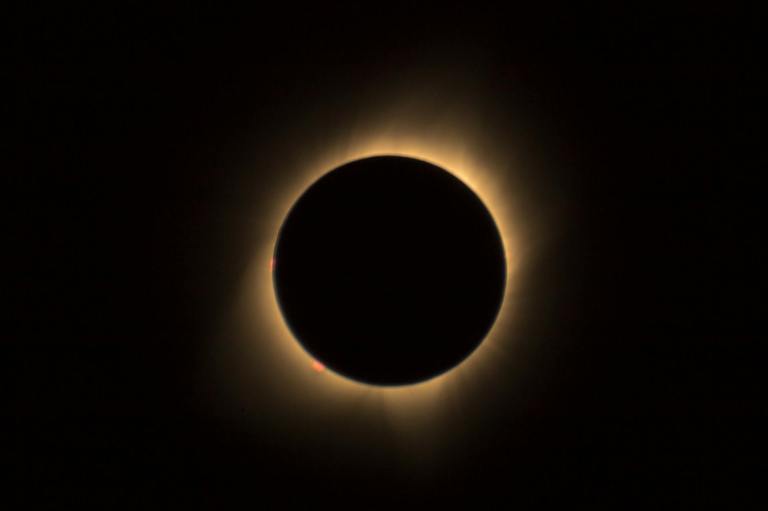
On the 8th of April 2024, an eclipse darkened North America for 4 minutes and 28 seconds (Carter). This was a total solar eclipse meaning that the moon was perfectly aligned between the Earth and the sun, causing the sun’s light path to be disrupted.
What is an Eclipse?
An eclipse is an alignment of the earth, moon, and sun, there are many different kinds of eclipses; however, the most commonly known are the lunar and solar eclipse. A lunar eclipse occurs when the earth blocks the sun’s light from reaching the moon, causing the moon’s surface to visibly darken. This usually occurs around 1-2 times a year and is less common than a solar eclipse which occurs 2-5 times annually. A solar eclipse is when the moon intercepts the sun’s light and a shadow is cast upon the earth. There is also a total eclipse, which is when the moon completely obscures all light from the sun, causing the solar corona to be visible. This happens much less than both a lunar and solar eclipse, it transpires about once every 18 months.
The difference between the 2024 Solar Eclipse and others
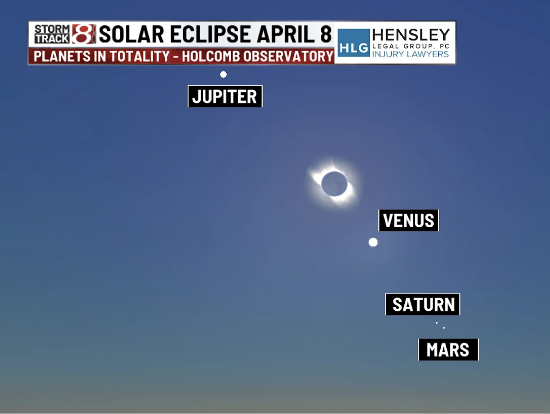
The 2024 eclipse has been a major event as the totality occurred for longer than it has in the last 100 years. Totality is the phase in which the sun’s light is completely blocked by the moon. Not only was the totality so long but the sun’s corona was extremely visible, this is because the sun is close to its maximum solar output in the solar cycle, which happens every 11 years. This eclipse was even more special because four other planets were also visible – Venus and Jupiter were seen next to the eclipse and if you paid close attention Saturn and Mars could also be seen, which further added to the event.
The next eclipse will take place on the 2nd of October 2024. This eclipse will be another solar eclipse and will begin its path in the Southern Pacific Ocean and will then cross over Chile and Argentina, the eclipse will finish its path in the southern Atlantic Ocean (An annular).
Works Cited
- An annular solar eclipse, sometimes described as a “ring of fire” is different from a total solar eclipse in that the view of the sun is never completely blocked by the moon. Therefore it is never safe to look directly at an annular eclipse without proper eye protection, such as solar eclipse glasses that meet the ISO 12312-2 standard. Prevent Blindness, preventblindness.org/solar-eclipses/october-2-2024-annular-solar-eclipse/#:~:text=The%20direction%20of%20the%20eclipse,in%20the%20southern%20Atlantic%20Ocean. Accessed 19 Apr. 2024.
- Carter, Jamie. “Total solar eclipse 2024: Everything you need to know.” Space.com, 16 Apr. 2024, http://www.space.com/41552-total-solar-eclipse-2024-guide.html. Accessed 19 Apr. 2024.
- Czachor, Emily Mae. “Why do total solar eclipses happen? Learn what will cause today’s celestial show.” CBS News, 8 Apr. 2024, http://www.cbsnews.com/news/why-total-solar-eclipses-happen-2024/. Accessed 19 Apr. 2024.
- Lea, Robert. “The April 8 solar eclipse will bring weird sights, sounds and feelings.” Space.com, 6 Apr. 2024, http://www.space.com/solar-eclipse-april-2024-strange-phenomena. Accessed 19 Apr. 2024.
- Planets to look for in Indianapolis (totality begins 3:06 p.m., April 8, 2024). WishTV.com, 6 Feb. 2024, http://www.wishtv.com/news/solar-eclipse/aprils-total-eclipse-will-reveal-a-multitude-of-planets-and-stars-in-the-sky/. Accessed 19 Apr. 2024.Rao, Joe. “Total solar eclipse April 8, 2024: The longest and most visible for the US in 100 years.” Space.com, 26 Jan. 2024, http://www.space.com/total-solar-eclipse-april-8-2024-finest-for-united-states. Accessed 19 Apr. 2024.
 Posted by
  ISB MUN